
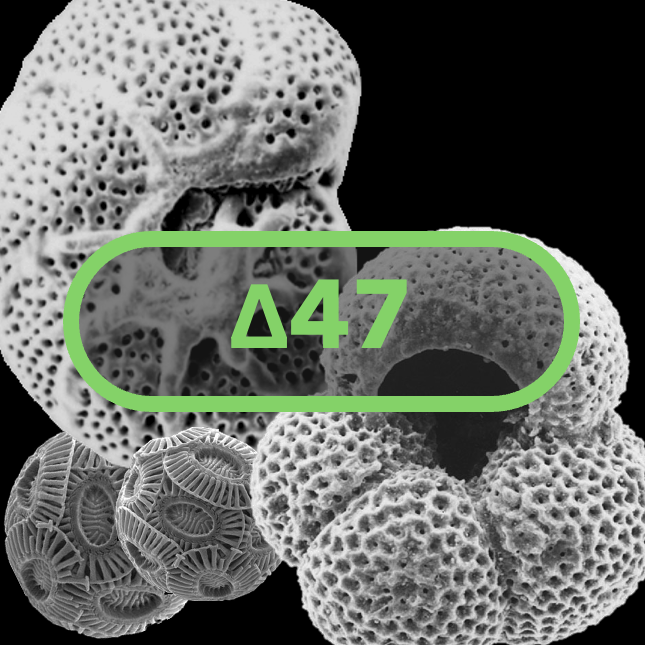
Clumped isotope thermometry measures the natural “clumping” of heavy isotopes within carbonate minerals, providing a temperature estimate that is independent of seawater chemistry. Recent analytical and calibration advances allow foraminiferal or coccolithophore samples to yield precise temperatures with well‑quantified uncertainty. Because Δ47 is unaffected by changes in seawater δ18O or Mg/Ca, it offers a powerful and complementary constraint on Miocene climate evolution.
‘Cap-47’ (Δ47), or carbonate clumped isotopes, are based on comparing three pieces of isotope information at the same time: the bulk oxygen isotope composition (δ¹⁸O), the bulk carbon isotope composition (δ13C), and the proportion of molecules with both of those heavy rare isotopes bonded together on the same ion. Using the bulk δ18O and δ13C information, the stochastic value of δ47 is calculated; this is compared to the measured δ47 value, which represents the proportion of sample that actually contains this double heavy rare isotope substitution. From these two values, the sample’s Δ47 is calculated. Due to the thermodynamic properties of bonds between atoms, lower temperatures favour more grouping of the heavy rare isotopes together, resulting in a higher Δ47 value. The benefit of leveraging Δ47 rather than the directly measured δ47 (i.e., the difference between how many carbonate ions are expected to have a double substitution with how many ions actually have the double substitution) removes the dependence on factors such as the seawater oxygen isotope composition the mineral formed in, a value that becomes harder to estimate further back in time. This proxy has also been shown to be relatively insensitive to organism vital effects (in many, but not all, cases), as well as other aspects of seawater chemistry which are likewise difficult to estimate for the geological past. While there are still some details of this proxy being examined, for example if there are significant effects due to changes in seawater pH, the main drawback of Δ47 for paleotemperature reconstruction is the relatively large amount of sample material required, relative to the amount of available fossil material in sediment cores. This requirement has improved dramatically in recent years, alongside method standardisation and interlaboratory reproducibility, making this a proxy capable of providing robust paleotemperature estimates even into deep geological time as long as there is well-preserved carbonate available.