
MioOcean is a global database of Miocene ocean temperature proxy data.
It serves as a resource for anyone interested in understanding Miocene climate between 5 and 23 million years ago.
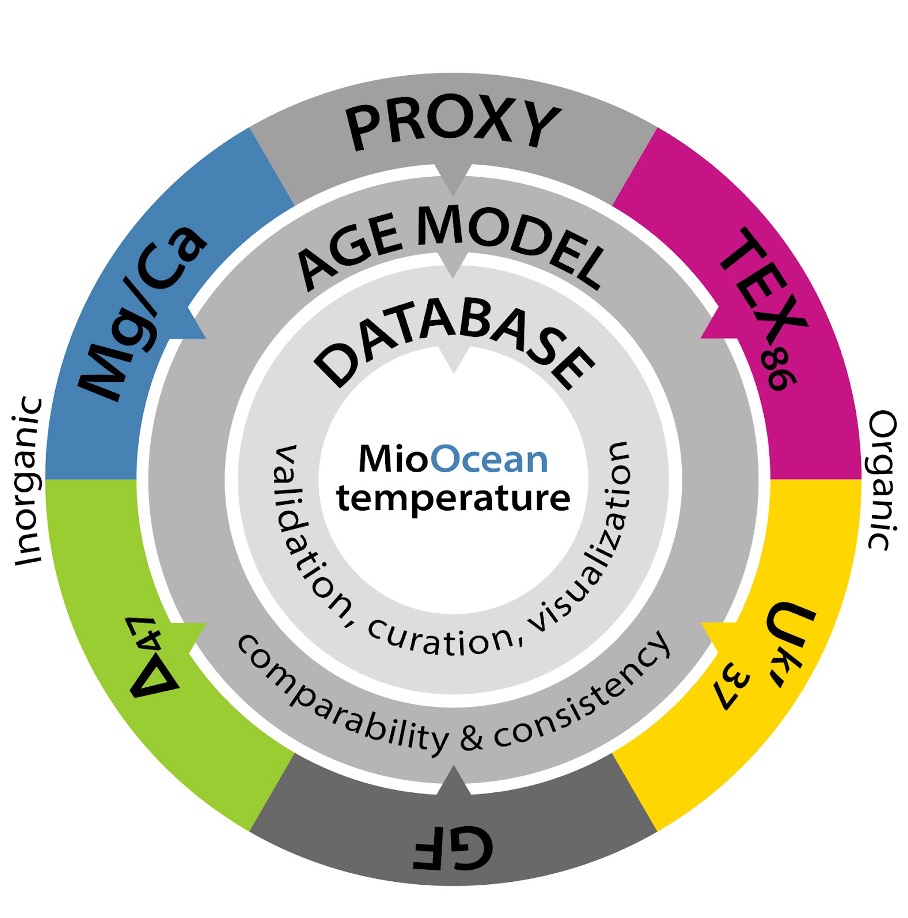
The database is compiled and maintained by the MioOcean Temperature Synthesis Working Group, a subgroup of PAGES PlioMioVAR whose goal is to update age models of existing ocean temperature records, integrate heterogeneous datasets, and ultimately create a global temperature atlas for the Miocene.
Paleotemperatures
We reconstruct past ocean temperatures using organic and inorganic temperature proxies obtained from marine sediment cores and terrestrial outcrop sections.


Within MioOcean, we emphasize the collaboration between stratigraphers and geochemists to ensure robust comparisons of temperature patterns across space and time. In tandem with the temperature synthesis, we revise and update age models to a state-of-the-art level. In the current MioOcean database, there are revised and/or verified age models of 38 key sites.
MioOcean age models
Meet the team
We are a large international group of 55 people across 7 different working groups led by the MioOcean steering committee.
Building on the PAGES PlioVAR framework, MioOcean extends this collaborative approach into the Miocene through the PAGES PlioMioVAR Working Group.
Initiated in 2022, this ongoing synthesis brings together specialists in five proxy groups, age modelling, and database management to compile, recalculate, and integrate Miocene ocean temperature records.
FAQs
What is MioOcean?
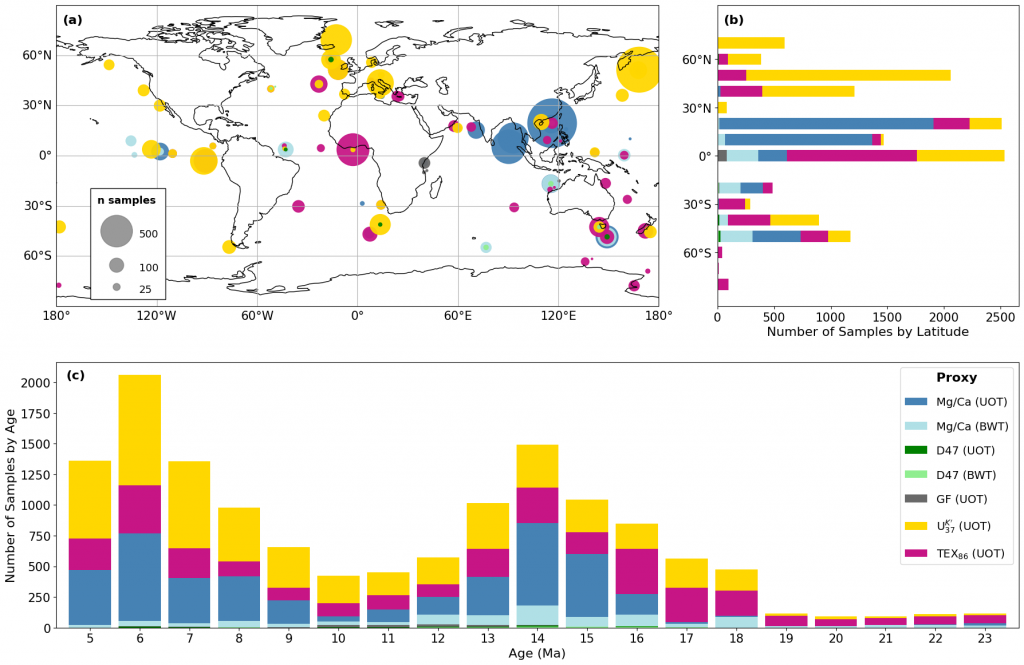
MioOcean is a scientific initiative aiming to make Miocene ocean temperature information available to the wider community in a standardized, accessible manner. Our primary product is a database and interactive website hosting as many Miocene ocean temperature records as possible. Records are derived from published articles, and their data is standardised and updated (if required) to be consistent with current data processing methods. In addition, for several key locations or ‘sites’, the age model information was also updated. Both of these tasks were, and are, gargantuan undertakings; nonetheless, the MioOcean initiative has so far produced a data compilation comprising 22,941 data points from 101 scientific studies, with revised and standardised age models for 38 key sites. MioOcean is a sub-group of the PAGES PlioMioVAR working group (https://pastglobalchanges.org/news/128950); we are grateful for their financial support.
Why is the Miocene important?
Parts of the Miocene (5.3 to 23 Ma) were warmer than present, with CO2 levels similar to both today and those projected for the near future with continued anthropogenic release of CO2 to the atmosphere. This means parts of the Miocene are useful for assessing how Earth’s oceans responded to climate variations in the past. The MioOcean database makes it easier for climate modelers to find and use Miocene ocean temperature information to validate and assess their model outputs, which in turn helps improve predictions of climate responses to anticipated future warming.
What are proxies?
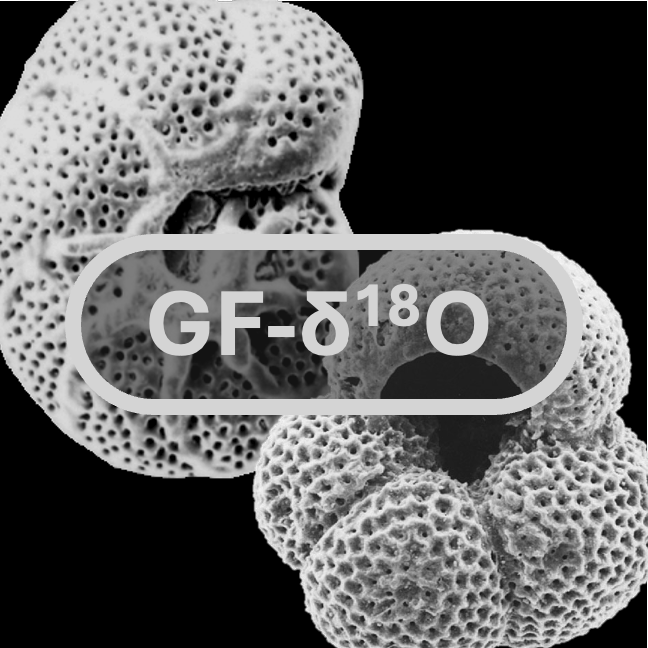
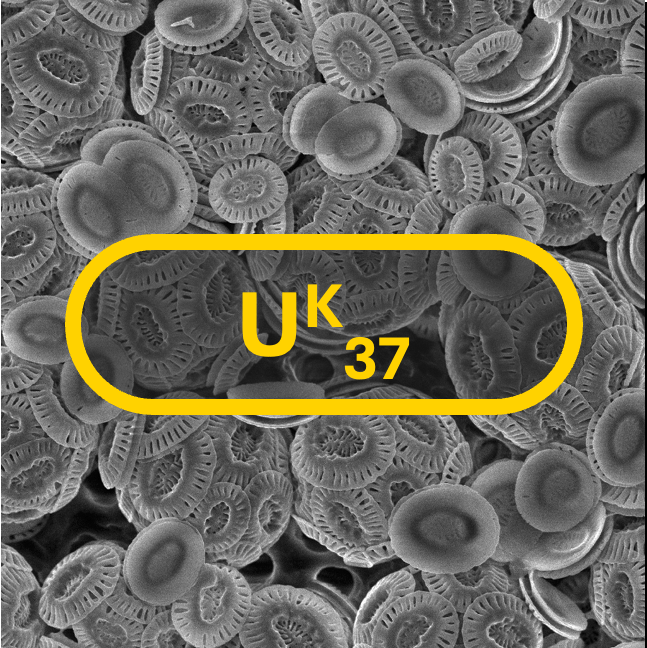
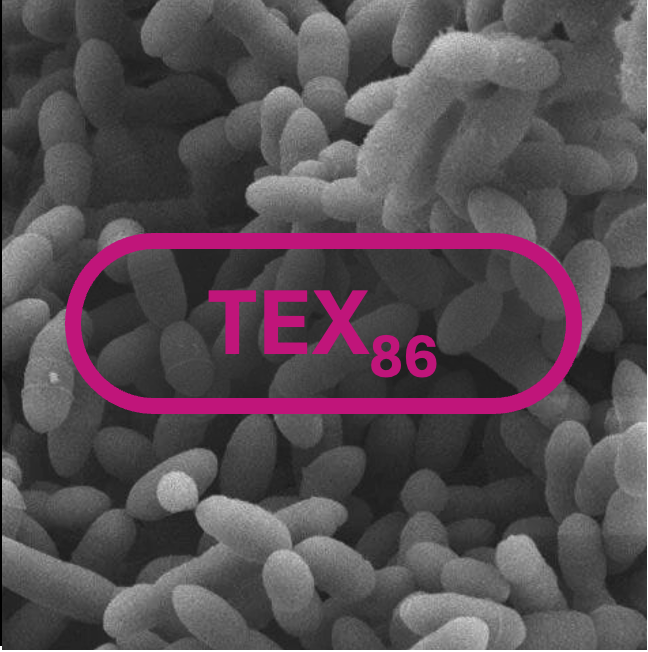
In the geological or paleoclimate sense, a proxy is a measurable characteristic of an archive that can be used to infer information about the environment it formed in. MioOcean focuses on paleotemperature proxies, which are based on a geochemical signature preserved within fossils and sediments. For example, for nearly a hundred years, researchers have been using the oxygen isotope composition of fossil shells to infer the temperature the original organism grew in. This is possible because the organism built their shell while they were living, out of material taken from its environment, such as the water it lived in, and anything dissolved in that water. Changes in oxygen isotopes, denoted δ18O, captured within the carbonate shells of organisms that lived in the ocean (e.g. clam shells, but more commonly, microscopic shells from organisms called foraminifera) are now understood to represent a few different parameters, the most important of which are related to climate: ocean temperature; global ice sheet volume; and salinity, which is controlled by the hydrological cycle. Since the development of δ18O as a paleotemperature proxy, several others have been developed which similarly use a geochemical imprint to infer past temperature. These are other inorganic proxies such as trace element ratios (Mg/Ca), and position specific carbon and oxygen isotopes in carbonate (Δ47). There are also organic proxies, which use complex molecules such as the long chain fatty acids produced by organisms in their cell membrane, which can be preserved for millions of years in marine sediments; the MioOcean initiative compiled the two most common, UK’37 and TEX86. All work in a similar manner: a geochemical characteristic of that proxy changes in response to climatic factors such as temperature, and we measure those values to generate records of past climate change, or in the case of MioOcean, ocean paleotemperature.
What are foraminifera and why do they matter for the ocean?
Foraminifera are microscopic (on the order of 1 mm, or about the thickness of a fingernail), single-celled organisms that live across the Earth’s oceans. Those living in the upper ocean are called planktic or planktonic foraminifera, while those living at the bottom are called benthic foraminifera. They form shells, known as tests, for protection and support; many foraminifera secrete calcium carbonate to make this test themselves, and these tests incorporate the geochemical signatures of the environment they lived in. After their lifecycle, their tests fall to the bottom of the seafloor and are buried in the sediments, left behind for us to find, classify, and measure. Different types of foraminifera, at least in the form we recognize today, have existed for around 540 million years. In the modern oceans, we observe that they form an integral component of oceanic food webs, are distributed nearly universally across the globe, and that their spatiotemporal distributions change in response to factors affecting their ecology. Their ubiquity in marine sediments all over the globe has made foraminifera an integral archive of paleotemperature proxies for researchers studying different facets of Earth’s past climate.
How are MioOcean data collected?
MioOcean compiles published Miocene ocean temperature records from around the world, integrating data from inorganic and organic geochemical proxies across ocean drilling sites, onshore cores, and marine sedimentary outcrops. Data are sourced primarily from peer reviewed publications and public repositories. An international network of scientists including, inorganic and organic proxy specialist, stratigraphers and data scientists, review publishes records including meta data, proxy values, uncertainty, and chronology. Using MioOcean framework and updated proxy systematics, upper ocean and bottom water temperatures are derived from proxy archives and age models refined. The resulting database provides internally consistent temperature reconstructions with associated uncertainties and updated chronological information. This database supports comparisons of ocean temperature changes across different regions and through the Miocene as well as validation of climate model simulations against proxy data.
Why are multiple proxies needed to reconstruct past ocean conditions?
Robust reconstructions of past ocean temperatures benefit from application of multiple proxies. Each proxy has unique strengths, assumptions, uncertainties, and sensitivities to factors such as temperature, seawater chemistry, biology, and preservation. Combining multiple proxies allows MioOcean to cross-validate temperature estimates, test proxy systematics and calibrations, and identify proxy-specific biases. It also helps extend reconstructions across global oceans, depths, temperatures, and the Miocene epoch addressing gaps in spatial and temporal coverage across this time interval. By bringing organic and inorganic proxy archives with updated chronologies within common framework, MioOcean provides a more robust and comprehensive picture of Miocene ocean conditions and helps guide future research.
How can educators or students use MiOOcean?
MioOcean provides accessible resources for educators and students to explore Miocene ocean temperatures and learn how past climate is reconstructed. The website includes background information on the temperature proxies used, the MioOcean scientific community working on Miocene climate, and info on how a paleoclimate database is developed. An interactive Streamlit dashboard allows users to explore the data through maps, plots, and other visualisations, with filters for proxy type, temperature calibration, location, and time interval. These tools provide a hands on way to investigate patterns in past ocean temperatures, compare different proxies, and explore how data selection and calibration choices influence reconstructions. We encourage educators and students to reach out to the Steering Committee for support when using MioOcean as a resource.
Can I download or reuse MioOcean datasets?
Yes. The MioOcean database is openly available on Zenodo: the temperature compilation at https://doi.org/10.5281/zenodo.22258386 and the age model compilation at https://doi.org/10.5281/zenodo.22258615.
To cite the MioOcean temperature compilation, please cite both the MioOcean database paper and the archived dataset:
Sosdian, S. M., Auderset, A., Modestou, S., Holbourn, A., Boscolo-Galazzo, F., Drury, A. J., Hess, A. V., Kochhann, K. G. D., Liebrand, D., Liu, X., Nirenberg, J., Shah, N. S., Tangunan, D., Auer, G., Badger, M. P. S., Bolton, C., Clark, A., Crocker, A., Evans, D., Feakins, S., Herbert, T., Judd, E., Kasbohm, J., King, D., Krijgsman, W., Kuhnt, W., Lawrence, K., Lear, C. H., Marshall-Mills, K., McClymont, E., Meckler, N., Minton, P., Nilsson-Kerr, K., Ochoa, D., Robinson, M., Sakthivel, T., Sangiorgi, F., Shevenell, A. E., Si, W., Sibert, E., Sliwinska, K. K., Sluijs, A., Stoll, H., Taylor, V., van Peer, T., Wade, B., Westerhold, T., Wubben, E., Zhang, Y., and Ziegler, M.: MioOcean: database compilation and temperature proxy systematics in the Miocene oceans, Earth Syst. Sci. Data Discuss. [preprint], 2026.
Sosdian, S., Auderset, A., et al. (2026). MioOcean temperature compilation [Data set]. Zenodo. https://doi.org/10.5281/zenodo.22258386.
To cite the MioOcean age model compilation, please cite both the MioAGE paper and the archived dataset:
Drury, A. J., Tangunan, D. N., Liebrand, D., Auer, G., Kasbohm, J., King, D. J., Westerhold, T., Crocker, A. J., Kochhann, K. G. D., Kuhnt, W., Ochoa, D., van Peer, T. E., Krijgsman, W., Robinson, M. M., Shah, N. S., Sibert, E. C., Wade, B. S., Sosdian, S. M., Auderset, A., Modestou, S., and Holbourn, A.: The MioOcean Age Framework: an age model database and chronoinformatics approach for synchronised Miocene ocean temperature, climate and proxy records, Earth Syst. Sci. Data Discuss. [preprint], 2026.
Drury, A. J., Tangunan, D., et al. (2026). MioOcean age model compilation [Data set]. Zenodo. https://doi.org/10.5281/zenodo.22258615.
If you use proxy-specific subsets, please also cite the relevant companion paper (MioTEX, MioMG) and the original data sources listed in the database.